An Independent Analysis of 20 Years of SDCI Enforcement Records
STLCA analyzed 233,543 Seattle Department of Construction and Inspections records spanning 2003 through 2025. This briefing is built from the City’s own public data and structured to show what the public record documents, what it does not document, and where that gap matters for oversight.
Who We Are
STLCA analyzes publicly available City of Seattle enforcement records to produce structured, verifiable assessments of how housing code compliance is documented, and where the public record cannot confirm that enforcement occurred. We are not a tenant advocacy organization, and we do not represent any party in any proceeding. We present what the data shows, measured against itself and against the legal obligations of the agencies responsible for maintaining it.
We are here as a resource to the Council. The patterns documented in this briefing developed across multiple administrations. This is not an argument about personalities. It is an evidence-based review of what Seattle’s own public enforcement record does and does not show.
What We Found
We analyzed 233,543 SDCI enforcement records and produced a structured accountability review. In doing so, we identified that Seattle Municipal Code Section 22.206.180 required SDCI to deliver exactly this kind of report to the City Council every year beginning June 15, 2017.
That report was never filed. Not once in nine years.
What follows is the report the City owed, built from the City’s own data.
Section 9 was added as a standalone amendment to create a mandatory annual accountability mechanism. The reporting deadline was set at June 15 of each year, beginning in 2017. The full ordinance passed 8 to 0. Section 9 has never been fulfilled.
| Required by Ordinance | Status | What STLCA Found From Public Record |
|---|---|---|
| Number of inquiries from tenants and landlords | Available | 41,653 LLT complaints filed from 2003 through 2025. 58,761 total LLT records including complaints, NOVs, citations, and relocation orders. Derived from 233,543 total SDCI records. |
| Number of inspections conducted related to those inquiries | Available | 62.3% of LLT records, 36,633 of 58,761 show no inspection date and no documented result. An additional 9 records show an inspection date but no result. 22,119 records, 37.6% include a documented inspection result. Peak documentation rate: 90.1% in 2013. Rate in 2025: 15.1%. |
| Outcomes of those inspections | Available | 59.8% of closed LLT cases show no documented inspection result, despite being marked completed or closed. 11,341 Notices of Violation issued citywide. 48 cases formally referred to law in more than 20 years. 5,936 LLT cases remain open. |
| Housing cost increases delayed based on Department determination | Not in data | Not in the public record, and that is the finding. Section 9 required SDCI to track and report housing cost increases delayed under 22.206.180.J. No public record shows that such a tracking system was ever built. |
| Refunds or credits ordered from landlords | Not in data | Not in the public record, and that is the finding. Required annually. No public dataset, annual report, or disclosed tracking system has been identified. |
| Eviction cross-reference to complaint addresses | Not in data | Not in the public record, and that is the finding. Section 9 specifically required SDCI to obtain eviction records and cross-reference them against complaint locations. No public record shows that methodology was built or performed. |
| Budget allocations for the program | Not in data | Not published in open data. Not included in any annual report to Council located by STLCA. |
Of the seven required annual report elements, STLCA can document three from SDCI’s public records. The remaining four do not appear in the public record at all. This is not a gap in STLCA’s research. It is evidence that SDCI did not build the tracking and reporting infrastructure Section 9 required. “Completed” and “Closed” appear in the data every year. Documented inspection outcomes do not.
You Said It First
These findings did not come from outside critics. They came from the data. But the concerns reflected in the data have also been raised by members of the Council for years. STLCA is not introducing a new theory. We are supplying the arithmetic.
“The Director shall report annually to the Affordable Housing, Neighborhoods and Finance Committee, or its successor committee, on all activity related to Section 22.206.180 J. This report shall include the number of inquiries from tenants and landlords, the number of inspections related to those inquiries, the outcomes of those inspections, the number of housing cost increases delayed based on a determination by the Department or refunds or credits required, and any interactions and information provided to the Department's involvement in any eviction proceedings. To the extent feasible, the Director should obtain records on evictions in Seattle and review those records to determine if the Department received any complaints at those locations related to Section 22.206.180 J and if the eviction resulted from application of the Section 22.206.180 J. The report shall be delivered to Council by no later than June 15 of the following calendar year, beginning June 15, 2017.”
These findings came from the data and from the legal framework the Council itself created. STLCA built the report the ordinance required and the City never delivered.
The 2018 Enforcement Collapse
The data does not show a gradual decline in documentation quality. It shows a structural break. Using SDCI’s own records, a clear before-and-after emerges at 2018.
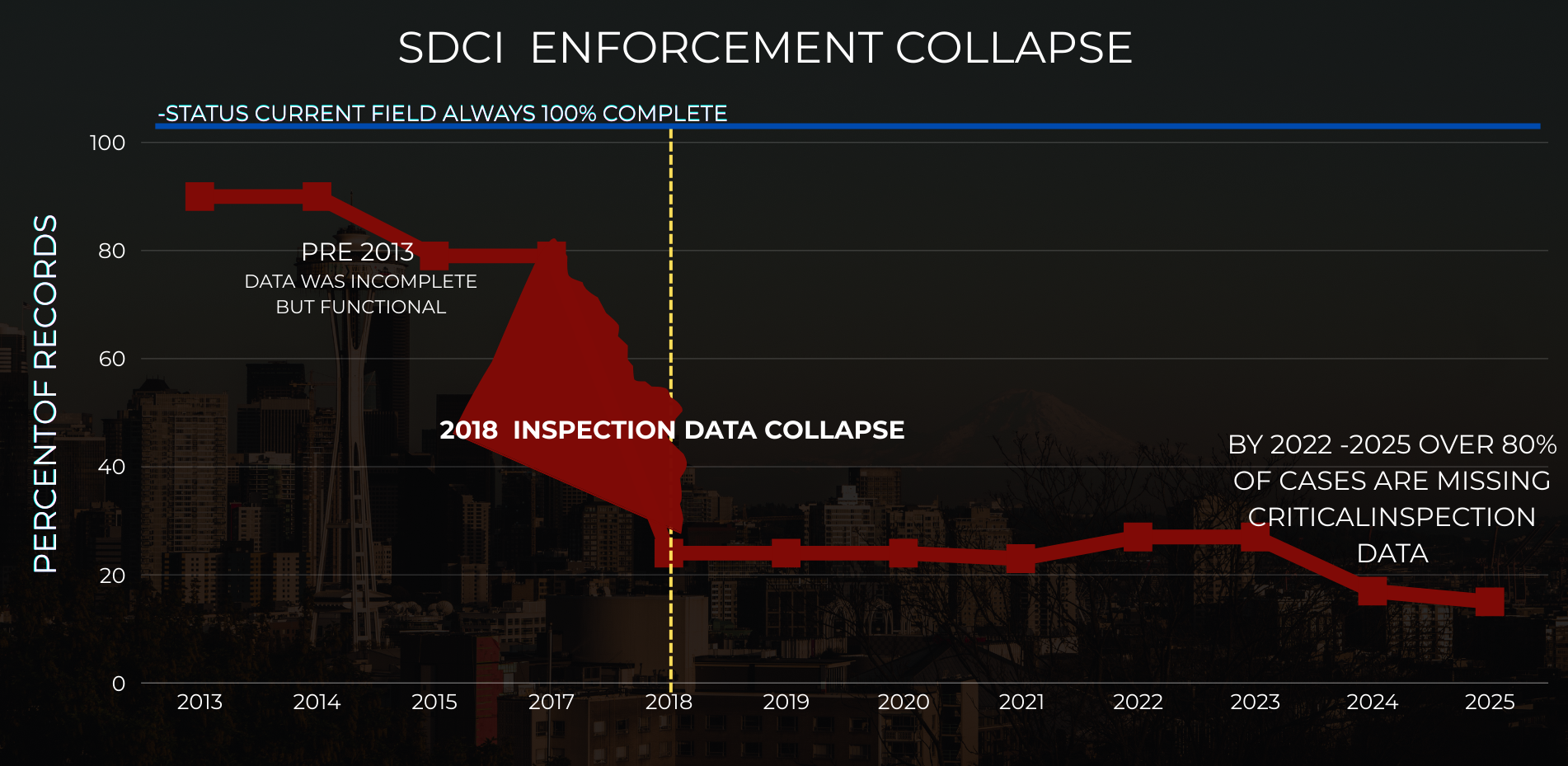
The City has preserved the appearance of enforcement while the public evidence of enforcement has thinned out. Status labels remain. Inspection results do not. That is the distinction between administrative closure and documented enforcement.
By Council District | LLT Record
2015 through 2025 only. “Closed / No Result” means LLT cases closed with no documented inspection result. 2,671 records, or 1.1%, could not be geocoded to a district and are excluded from district totals.
Ordinance 125054 | The Missing Reports
• The ordinance required the SDCI Director to report annually to City Council. Required elements included inquiry counts, inspections, outcomes, rent increase delays, refunds or credits, eviction cross-referencing, and budget allocations.
• Zero reports were filed. STLCA found no annual reports covering 2017 through 2025.
• When contacted, SDCI’s RRIO Manager responded in writing: “We’ve never prepared such a report… 22.206.180.J doesn’t exist… makes a jump from I to K.” The signed ordinance is a public record.
• The issue is not that the data was impossible to produce. The issue is that the reporting obligation was not performed.
Financial Context
Seattle is operating under budget pressure. SDCI’s enforcement function, including the issuance and collection of fines and penalties, depends on whether violations are documented, pursued, and carried through to collection.
When 59.8% of closed landlord-tenant cases show no documented inspection result, the enforcement chain is already broken at the point where evidence should exist. Without documented enforcement activity, downstream fine issuance and recovery are impaired before they begin.
STLCA does not assert a citywide uncollected revenue figure in this briefing. What the public record does show is that the documentation infrastructure required to pursue many enforcement outcomes was missing in the majority of closed LLT cases. The Council is in a position to direct SDCI to quantify the financial consequence of that breakdown.
STLCA reviewed SDCI’s Notice of Violation records for one documented property in District 7 and applied the City’s own fine formula: $150 per day for the first 10 days of non-compliance, then $500 per day thereafter. Across 17 documented NOV records spanning 2008 through 2024, the calculated fine obligation reaches:
Complaints at this address documented no heat for months, bed bug and roach infestation, flooding, caved-in ceilings, mold, locked-out kitchen access, and management entry without notice. Residents filed the complaints. SDCI opened the cases. SDCI marked them completed. Using the City’s own formula, the calculated obligation exceeds $24.2 million. The public record documents $475 collected.
STLCA has normalized, classified, and structured more than 20 years of complaint and enforcement records; cross-referenced them against RRIO-related material; organized them by council district; and evaluated them against standing legal obligations that remain on the books.
This work is public, replicable, and available to every council office, every Seattle resident, every journalist, and every policymaker who wants to understand what SDCI’s own public record shows. STLCA is prepared to continue that work as an independent data resource.
What We Are Asking For
What STLCA Is Asking City Council to Do
Seattle maintains independent oversight bodies for several city functions, but none of them cover housing code enforcement:
- City Auditor - audits financial management and program efficiency, but does not investigate individual enforcement complaints or department conduct.
- Office of Inspector General (OIG) - reviews Seattle Police Department. Jurisdiction is SPD only; no authority over SDCI or housing enforcement.
- Ethics and Elections Commission - investigates ethics violations by individual employees; does not audit systemic enforcement practices or departmental performance.
No body currently has the mandate to review whether SDCI is properly documenting, inspecting, and closing housing complaints. STLCA recommends four steps.
When the Numbers Become People
The percentages above represent actual complaints from actual residents living in actual buildings across Seattle. Three documented examples show how administrative closure without reliable inspection documentation translates into real-world outcomes.
Full case study documentation is available at STLCA Case Study Index. Interactive district and citywide dashboards are linked below.
Every number in this briefing is derived from SDCI’s own public records.
Access the Full Data
Per-district enforcement dashboards with LLT records, trends, top properties, keyword analysis, and oldest-open cases:
Full repository with source data, methodology, scripts, and case study index:
seattletlca-justice.github.io/DATASETS_AND_DASHBOARDS
Seattle, Washington
Independent Oversight • Verified Evidence • Public Accountability
www.seattletlca.com • March 2026
All data in this briefing is derived from the Seattle Open Data Portal and is independently verifiable. STLCA is not affiliated with the City of Seattle, SDCI, or any City department. This briefing does not constitute legal advice and does not assert legal conclusions regarding any individual, organization, or property. The findings reflect what is and is not documented in the public record.